Cryptogram: Word Logic Puzzles
- 4.6
- Rating
- 10.00M
- Installs
- Free
- Price
 Analysis by App-foxy
I first noticed Cryptogram: Word Logic Puzzles as the kind of game that fits naturally into small gaps in the day. It is a word game from Gismart, built around decoding, rearranging, and searching for language patterns rather than quick reactions. I can open it while waiting for an appointment, play a few puzzles, and stop without feeling that I have abandoned a complicated campaign. That simple rhythm makes it especially interesting on a shared household device, where different people may want a short mental challenge at different times.
The game is free to download and is rated for Everyone, which gives it a broad audience. Its store summary points to logic word searches, scrambled letters, brain training, and daily crossword-style play, but my impression is more specific: the appeal comes from gradually turning a confusing group of letters or clues into something readable. The experience is less about vocabulary trivia and more about noticing structure. If you enjoy solving before looking for help, there is a satisfying moment when the answer suddenly becomes obvious.
How Cryptogram fits into a shared household
A realistic use case is a tablet or phone that spends the morning with one person, the afternoon with another, and the evening on a kitchen counter. One family member might use the game as a quiet break after work, while a teenager tries a puzzle between other activities. Someone else may simply enjoy solving a few clues before bed. Because the basic activity is self-contained, it does not require the whole household to be available at the same time.
You May Also Like

 Blood Strike: 2.5 Anniversary
Blood Strike’s Loadouts Turn Every Drop Into a Tactical Gamble
A close look at Blood Strike’s custom loadouts: how fast access to signature weapons reshapes its battle royale rhythm, rewards preparation, and narrows the gap between fights.

 Pandora - Music & Podcasts
Pandora’s Music Is Easy to Start, but Harder to Recover
Pandora’s strength is its low-effort path from a seed to a station. Its weak spot is how much confidence it asks you to place in connection, setup, and quiet recovery.

 8 Ball Pool
 Is Built on Rivalries, Rematches, and Routine
A close look at the rivalries, rematches, shared routines, and unanswered safety questions that turn a quick pool match into a persistent mobile community.

 Samsung Music
’s Quiet Strength Is Playing What You Already Own
Its reach comes less from spectacle than from dependable access to a personal library. That simplicity is both the app’s strongest retention engine and its ceiling.

 AccuWeather: Weather Radar
AccuWeather Review: A Quick, Clear Forecast for Everyday Decisions
For everyday plans, the best forecast is the one you can understand quickly. AccuWeather makes rain timing, radar, and local conditions easy to act on, with a few trade-offs.

 Hill Climb Racing
Why Hill Climb Racing Still Turns Crashes Into One More Run
A tiny car, a bumpy hill and one more upgrade: Hill Climb Racing keeps resurfacing because its simple chaos makes every near-miss feel personal.
More From Our News Desk



That shared-device appeal has an important limitation: I would not treat the game as a naturally collaborative family board game. The core experience is individual problem solving. Two people can discuss a difficult word or pass the device around, but the app itself should be approached as a personal puzzle space rather than a coordinated multiplayer activity. If your household wants a game where everyone contributes to one visible board, a traditional word board game may be a better fit.
The strongest shared-use pattern is informal turn-taking. One person solves a puzzle, leaves the phone available, and another person starts a separate session when convenient. I would avoid assuming that progress, preferences, or achievements are automatically separated between users. On a device used by several people, the safest practical approach is to agree on whose turn it is and avoid changing settings or spending money without asking.
This matters because word puzzles can invite “just one more try” behavior. A player may want to revisit a stubborn clue, while another person may prefer to move on. In my experience, the game works best when the household treats it like a shared book of puzzles: enjoy your own attempt, discuss answers if everyone wants to, and do not spoil a solution for the next person.
What the first session feels like
The opening experience is easy to understand because the central action is familiar: inspect letters, identify a possible word or phrase, and use logic to narrow the answer. I did not need a long explanation to grasp what the game wanted me to do. That low entry barrier is useful when an older relative or a younger player picks up the device without wanting a tutorial-heavy game.
Still, “easy to start” does not mean every puzzle is easy to finish. The challenge comes from the gap between recognizing individual letters and understanding how they fit together. When I rushed, I tended to lock onto the first plausible answer. Slowing down and checking the entire pattern was more reliable. My practical tip is to read the available letters as a group before tapping rapidly; the extra pause often reveals whether a guess actually fits.
Another useful habit is to separate certainty from possibility. If one part of a puzzle looks obvious but the rest remains unclear, I treat that answer as a hypothesis rather than a solution. This prevents a common word from steering the entire attempt in the wrong direction. That small change in approach makes the game feel more like deduction and less like random guessing.
Keeping boundaries clear on a shared device
Before installing any free game on a household phone, I would establish a few simple boundaries. The first is who is allowed to make purchases. Cryptogram includes in-app purchases ranging from $0.99 to $99.99 per item, so the word “free” describes the download, not necessarily every optional transaction connected with the app. I would make sure children know not to confirm a purchase and that adults agree on who handles payment decisions.
The second boundary is personal space. A puzzle app may look harmless, but a shared device can contain notifications, saved accounts, or other private material. I would hand the phone over only when the owner is comfortable with that arrangement. This is not a criticism of the game; it is simply good practice whenever several people use one screen.
The third boundary is progress. If multiple household members use the same installation, I would not assume that each person has an independent profile or separate puzzle history. Instead, I would decide whether everyone is happy sharing the visible state. If that is inconvenient, separate devices are a cleaner solution than trying to force one copy of the game to behave like a multi-user platform.
These boundaries also make the age rating easier to interpret. An Everyone rating suggests that the game is positioned for a wide age range, but it does not remove the need for adult guidance around purchases or device access. I would feel comfortable introducing the puzzle format to a child who enjoys words, while still supervising the surrounding device habits rather than assuming the rating answers every household question.
Coordinating play without turning it into homework
The daily-style puzzle idea can create a pleasant routine, but I would be careful not to turn it into a family obligation. A household might decide that each person solves one puzzle during breakfast, then compares approaches later. That can encourage conversation about spelling and reasoning without requiring everyone to play at the same speed.
A better coordination method is to share methods rather than answers. For example, one person can explain that they grouped likely letter combinations, while another can describe how they eliminated words that did not fit. This keeps the mental work intact and makes the game useful for discussion. Giving away the final answer too early removes much of the value, especially for a player who is still learning to recognize patterns.
I also like the idea of using it as a low-pressure transition activity. A parent could offer a short puzzle after homework, or an adult could use it as a screen break that is more mentally active than scrolling. The important word is “short.” If someone is tired or frustrated, continuing simply because a puzzle remains unsolved can make the experience feel like a chore.
For households with different language abilities, expectations should be realistic. A word game naturally favors players who are comfortable with the language used in its puzzles. A bilingual family may find that one person enjoys the challenge while another needs more time or prefers a different game. That difference is not a failure; it is a reason to let each person choose whether to participate.
Age, trust, and the limits of a broad rating
The Everyone rating is reassuring for a general audience, particularly because the game’s subject is language rather than combat or mature storytelling. I could imagine it appealing to children who like spelling, adults who enjoy brain teasers, and older players who want a quiet activity. Its straightforward premise also makes it less intimidating than a large game with many systems to learn.
At the same time, age suitability is not the same as equal enjoyment. A young child with a small vocabulary may find some puzzles discouraging, while an experienced word-game player may want more depth than a casual title provides. I would introduce it as an optional challenge, not as a test of intelligence. The most helpful support is to ask how the player approached the clue instead of immediately correcting them.
Trust also includes spending decisions. Since the game is free to start but offers paid items, I would explain that tapping a tempting option may lead to a transaction. On a family device, adults should review the purchase setup themselves and decide what rules apply. I would not let a child browse the game unsupervised if the device is connected to a payment method.
There is another trust issue that is easy to overlook: spoilers. In a shared household, one person’s completed puzzle can reveal the answer to someone else. If the game presents a common sequence of challenges, I would avoid discussing solutions in front of players who have not reached them. Even without formal family tools, a little consideration can preserve the experience for everyone.
Where it stands beside other word games
Compared with a conventional crossword app, Cryptogram feels more focused on decoding and letter logic than on filling a large grid with broad clues. That makes it approachable when I want a compact puzzle instead of a long session. A crossword is usually better for players who enjoy clue variety, themed grids, and a more expansive solving surface.
Compared with a spelling or vocabulary trainer, this game feels less like a lesson. I am not opening it primarily to study definitions or follow a structured course. I am opening it to work out a puzzle. That is a strength for relaxed play, but someone seeking measurable language instruction may prefer an educational app designed around lessons and review.
It also differs from fast word-matching games. Those titles often reward speed, streaks, or rapid recognition. Cryptogram’s appeal is more patient. I can pause, reconsider a pattern, and return to the clue without needing quick reflexes. Players who want energetic competition may find that pace too quiet, while people who dislike time pressure may appreciate it.
The main trade-off is depth versus convenience. A compact puzzle format is easy to fit into a busy day, but it may not provide the same sense of long-term progression as a larger puzzle collection or a dedicated crossword platform. I would choose it for accessible mental play, not because it replaces every other kind of word game.
Practical strengths and points of friction
One of the game’s clearest strengths is its immediate readability. The concept is understandable, the subject is familiar, and the puzzles encourage active thinking rather than passive viewing. Gismart has placed the game in the word category, and that description suits the experience better than a broad “brain game” label alone.
Its other strength is flexibility. I can use it alone, share a solving method with someone nearby, or make it part of a small household routine. It does not demand that every player commit to the same schedule. That makes it more practical than games built around synchronized sessions.
The friction comes from the limits of shared use and the possibility of paid options. A single installation may not be ideal for several people who want completely separate histories. The free entry point is useful, but I would still pay attention to purchase prompts and avoid assuming that every feature or convenience is included without cost.
I would also skip it if I wanted a strong social layer, a story, or a competitive leaderboard-centered experience. The game’s pleasure is in solving the immediate word problem. If that loop does not appeal to you, a different category will probably hold your attention longer. Likewise, players who become frustrated by unfamiliar words may prefer a title with hints, definitions, or educational explanations built into every challenge.
Performance, compatibility, and value
The current version is 3.1.0 and requires Android or iOS 10 or later, which gives it a relatively broad device range for people using older supported hardware. I would still check the operating system on a family phone before planning a shared installation, especially if the device has not been updated for a long time.
The game has reached over ten million installs, with an average rating of 4.6 from around 387 thousand ratings and roughly 9.3 thousand written reviews. Those figures suggest that the format has found a substantial audience, but I would interpret popularity carefully. A large audience confirms that the basic idea works for many people; it does not guarantee that its puzzle style will match your vocabulary, patience, or preferred level of challenge.
Because the download is free, trying it is straightforward from a financial point of view. The more important value question is whether you enjoy the core solving loop before considering optional purchases. I would spend time with the free experience first, then decide whether any paid item genuinely improves the way I want to play. For a shared device, that decision should be made by the account owner, not by whichever family member happens to be holding the phone.
My household verdict
After using it as a casual word puzzle, I see Cryptogram as a good match for households that want a quiet, individual activity that can still spark conversation. It works particularly well for adults who enjoy decoding, children who like word challenges with supervision, and mixed-age families that are comfortable taking turns without expecting built-in cooperation.
I would recommend setting expectations before sharing it: agree on purchases, respect each person’s progress, and do not assume that one installation provides separate personal spaces. Those small rules address the main household concerns more effectively than pretending the game is a family platform.
My honest recommendation is to try it when you want a calm, language-focused break rather than a complete multiplayer experience. The free starting point lowers the barrier, the Everyone rating broadens its audience, and the puzzle format is easy to explain. However, players seeking deep crossword construction, formal vocabulary study, or competitive group play should look elsewhere. For the right person, this is a pleasant little reasoning game; for a shared household, it is best enjoyed as an individual puzzle book that happens to live on the same device.
FAQs for Cryptogram: Word Logic Puzzles
01What is the main objective of Cryptogram: Word Logic Puzzles?
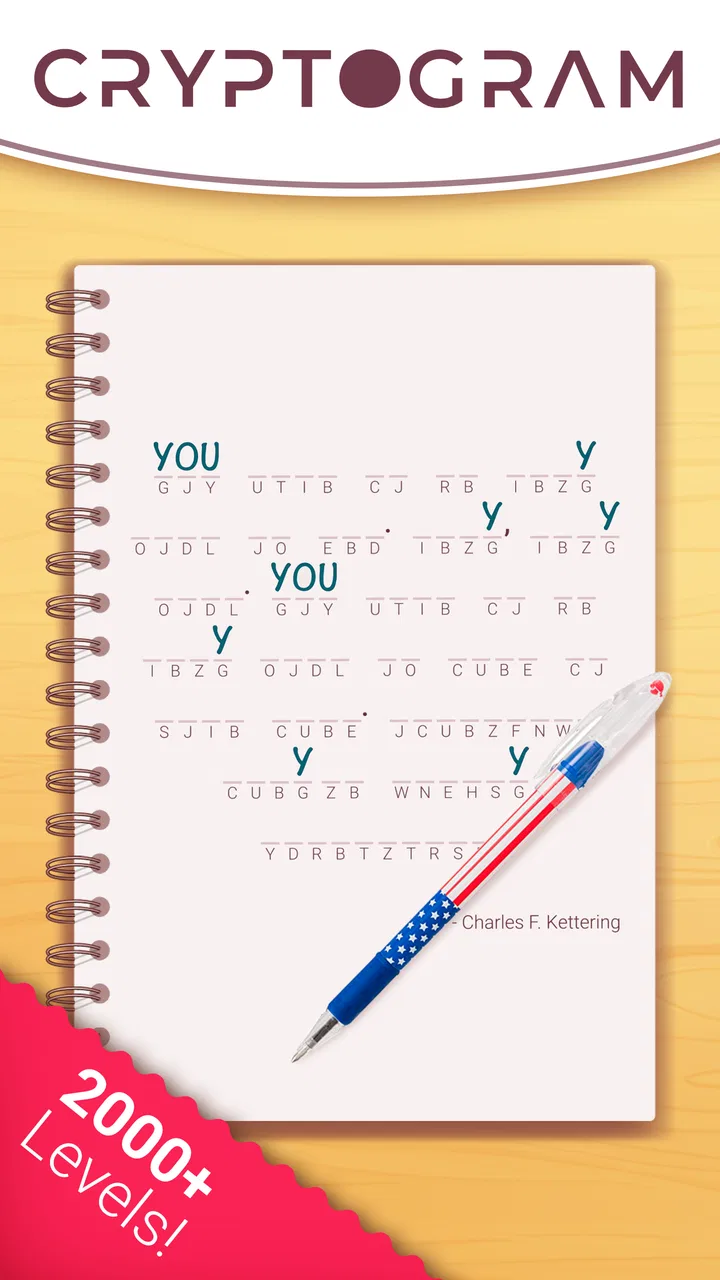
The main objective of Cryptogram: Word Logic Puzzles is to decode famous quotes by solving cryptograms. Each puzzle presents a scrambled message where each letter is substituted for another. Your task is to decipher the text by figuring out the letter replacements, testing your logic and problem-solving skills.
02Is Cryptogram: Word Logic Puzzles suitable for beginners?
Yes, Cryptogram: Word Logic Puzzles is suitable for both beginners and experienced players. The game offers varying levels of difficulty, allowing new players to start with easier puzzles and gradually progress to more challenging ones. The interface is user-friendly, and hints are available to assist players who may need extra help.
03Does Cryptogram: Word Logic Puzzles offer any in-app purchases?
Cryptogram: Word Logic Puzzles typically includes in-app purchases, which may offer additional hints or ad-free experiences. While the core gameplay is usually free, these optional purchases can enhance the gaming experience by providing more convenience or unlocking extra features for avid puzzle solvers.
04Can I play Cryptogram: Word Logic Puzzles offline?
Yes, Cryptogram: Word Logic Puzzles can usually be played offline. This feature is great for users who want to enjoy the game without relying on a constant internet connection. Whether you're on a flight or in a low-service area, you can still solve puzzles and enjoy the game.
05How does Cryptogram: Word Logic Puzzles maintain player engagement?
Cryptogram: Word Logic Puzzles maintains player engagement through a variety of features, including daily challenges, a wide range of categories, and a leaderboard to compete with others. The game regularly updates with new puzzles, ensuring players always have fresh content to explore and decipher.
Pros
- Engaging puzzles that enhance vocabulary
- Intuitive interface that's easy to navigate
- Regular updates with new challenges
- Offline play available for gaming anywhere
- Appealing graphics with a clean design
Cons
- Limited hints can be frustrating for beginners
- Ads can disrupt the gaming experience
- No multiplayer mode for competitive play
- Some puzzles feel repetitive over time
- In-app purchases can become costly

Cryptogram: Word Logic Puzzles
Gallery